.

Multi-Engine Rating (MER)

Categories

Complex Aircraft Operations

Client

Major Commercial Airlines, Corporate VIP Charter Operators, and National Regulatory Bodies (DGCA).

Project

Asymmetric Thrust Management Simulations, Advanced Instrument Rating (IR) Scenarios, and Live Piper Seneca Flight Endorsements.

Services

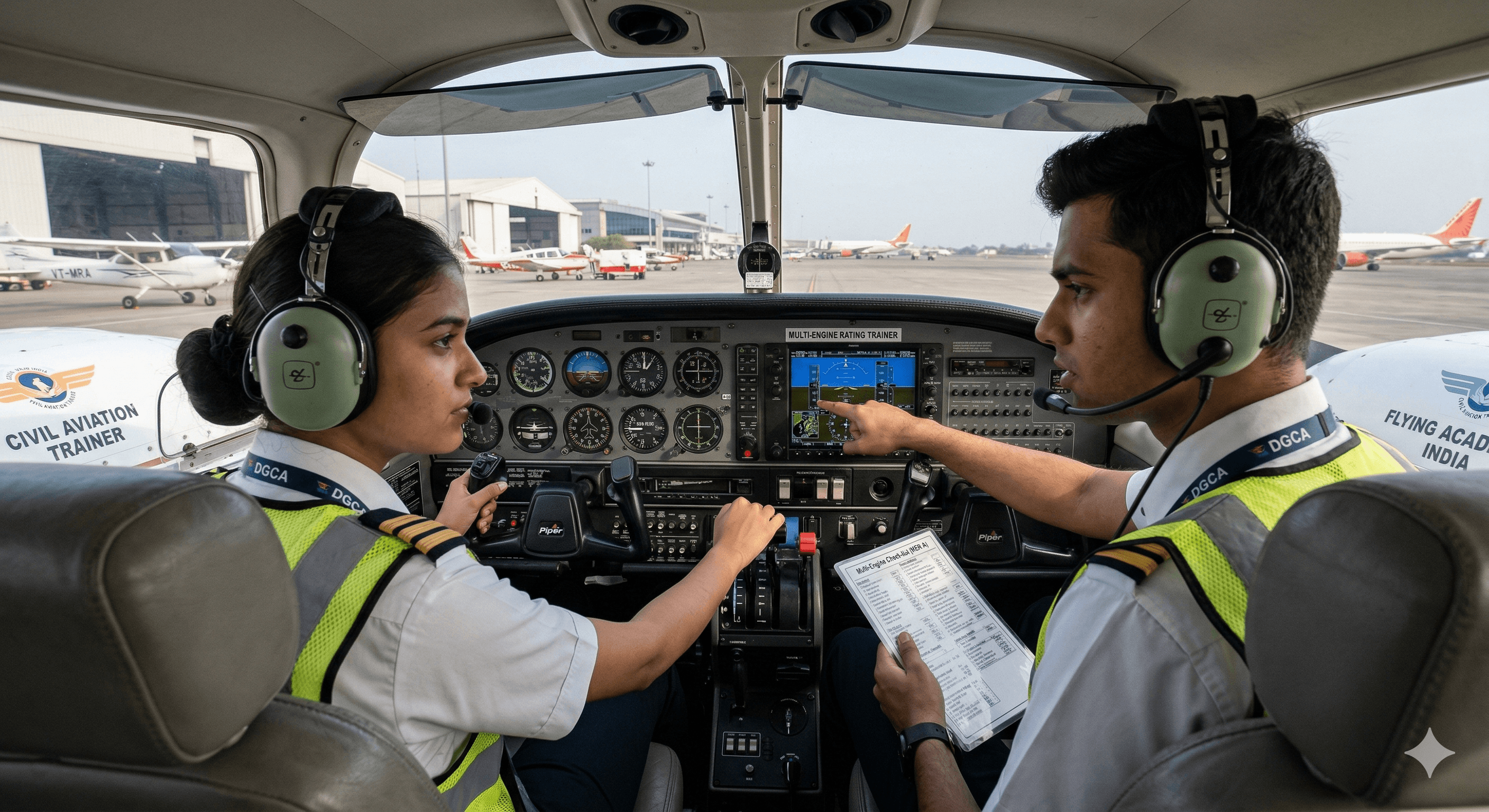
Program Introduction The Multi-Engine Rating (MER) is a critical operational advancement that transitions commercial cadets from basic single-engine flying to the command of complex, multi-engine aircraft like the Piper Seneca. This rigorous training focuses heavily on advanced instrument rules (IR), asymmetric thrust management, and high-stakes emergency procedures during system failures. It is meticulously designed to cultivate the absolute precision, discipline, and situational awareness required to safely navigate modern commercial airspace under adverse meteorological conditions.

Year

4
Fee Structure & Program Capacity The advanced flight training tracks, including the Commercial Pilot License with Multi-engine rating (IR) and Piper Seneca endorsements, are rigorously structured for an elite cohort. To ensure maximum simulator and flight line access, intake is strictly capped at 60 cadets per batch. The overarching CPL program requires a fee of 32,877 USD per head, while dedicated advanced simulator training is structured at 40,987 USD for an 18-month duration

Fee Structure & Program Capacity The advanced flight training tracks, including the Commercial Pilot License with Multi-engine rating (IR) and Piper Seneca endorsements, are rigorously structured for an elite cohort. To ensure maximum simulator and flight line access, intake is strictly capped at 60 cadets per batch. The overarching CPL program requires a fee of 32,877 USD per head, while dedicated advanced simulator training is structured at 40,987 USD for an 18-month duration

General Knowledge & Eligibility Candidates aiming to command complex, multi-engine commercial aircraft must first possess a strong foundational background, requiring a 10+2 qualification in Mathematics, Physics, and Chemistry (MPC). The curriculum transitions cadets from basic flying to advanced multi-engine instrument rules. Cadets must demonstrate extreme discipline, situational awareness, and the ability to interpret complex meteorological reports under adverse circumstances

General Knowledge & Eligibility Candidates aiming to command complex, multi-engine commercial aircraft must first possess a strong foundational background, requiring a 10+2 qualification in Mathematics, Physics, and Chemistry (MPC). The curriculum transitions cadets from basic flying to advanced multi-engine instrument rules. Cadets must demonstrate extreme discipline, situational awareness, and the ability to interpret complex meteorological reports under adverse circumstances

Curriculum & Practical Exposure The coursework demands absolute precision, covering extensive ground subjects like Air Navigation, Mass and Balance, and Principles of Flight alongside intensive Simulator Training. Upon successful completion, cadets achieve highly specific program outcomes. These include a Graded Student Activity Log, a Unique Identification Number, and the mandatory publication of a formal aviation research paper

Curriculum & Practical Exposure The coursework demands absolute precision, covering extensive ground subjects like Air Navigation, Mass and Balance, and Principles of Flight alongside intensive Simulator Training. Upon successful completion, cadets achieve highly specific program outcomes. These include a Graded Student Activity Log, a Unique Identification Number, and the mandatory publication of a formal aviation research paper